
The most common thing we hear after sending a quote is, “Your installation cost is a bit high.”
And honestly, that’s a fair thing to say — until you see what’s actually inside that number, and what’s quietly missing from the cheap ones. So let me just be straight with you and open the books.
Every week someone tells us they’ve been quoted $750 to $1,000 to install a full seven-channel system — sometimes with a projector too. Next to a proper quote, that sounds like a steal. And it makes an honest installer look expensive.
Here’s the thing though: an $850 install on a quality seven-channel system is either using cheap gear, or the money you think you’re saving has just been moved somewhere you can’t see it. Let me show you how.
Why the cheap number looks cheap
When you’re comparing installers, the one number you can actually line up side by side is the labour. You can’t easily check what cable someone used, or what plugs, or what mount — but you can absolutely compare “$850 install” against “$2,250 install.”
So guess which number gets advertised nice and low.
That money doesn’t disappear. If the install price is rock-bottom, the margin has usually just shifted onto the gear — the projector, the receiver, the “cable pack” — where you’ve got no way to price-check it. You end up paying the same or more. You just don’t see it on the line you were watching.
We don’t think that’s a fair way to treat people. So here’s ours, out in the open.
Let’s just do the maths
Before anyone even picks up a drill, here’s what the quality materials for a seven-channel-plus-projector job actually cost at normal retail:
| What it is | Why you need it | Roughly |
|---|---|---|
| Kordz / Bluestream HDMI 2.1 active optical cable, 48Gbps, 10m | 4K and 8K over a long run to the projector — normal copper just can’t do it at that length | ~$350 |
| 14 AWG speaker cable (Wirepath / Bluestream / Kordz) across 7+ channels | Thicker cable means less resistance over those long surround and ceiling runs | $250–$400 |
| Prime banana plugs for a 7-channel set | Proper, secure connections instead of bare wire twisted under a screw | ~$100 |
| Prime heavy-duty projector bracket (25kg rated) | A projector over your head has to be genuinely safe and not drift | ~$250 |
| Wall plates, brackets, conduit, bits and pieces | The boring stuff that makes it tidy and safe | $100+ |
That’s roughly $1,050 to $1,200 in gear alone — before a single hour of labour.
Now look at that $850 install again and ask the simple question: where are the cables, the plugs, the mount?
- If they’re included in the $850, they’re not this quality — there’s just no room in the number for it.
- If they’re on a separate line with the hardware, that’s where the margin went. You’re still paying it. You just can’t see it.
And that’s still only the gear. Now add the actual work. A proper job like this is two of us on site for a full day — running the cable, cutting into the plaster, mounting everything dead level and safe, and terminating every single speaker. Then, once it’s all in, comes the part that really takes skill: dialling in the calibration and sitting down to walk you through how the whole system works before we hand it over.
So before you sign off on an $850 quote, just ask yourself one honest question: how? Two people for a full day, all of that gear, then the calibration and a proper handover on top of it — for $850? It doesn’t add up, because it can’t. Something’s been left out, or something’s been marked up somewhere you can’t see it.
We don’t cut corners, and we don’t mislead people to win a job. We’d rather show you the real number and then earn it.
But here’s the part you’re really paying for
This is the bit nobody puts in an ad, because it’s the hard part.
Anyone can screw speakers to a wall and plug them in. Getting them to actually sound like a cinema — where the voices stay locked on the screen, a helicopter moves cleanly across the ceiling, and the bass hits your chest without turning to mud — that takes real engineering and calibration. And that’s exactly what the cheap installs skip.
Dolby Atmos isn’t just “more speakers.” It’s a standard, with real rules about where every speaker goes — the fronts, the surrounds beside and behind you, and the height or ceiling speakers overhead — all set to specific angles from where you actually sit. Put a surround on the wrong wall, or a ceiling speaker at the wrong angle, and the whole effect falls apart. The sound still plays. It just doesn’t land where the movie meant it to.
So before we mount a single speaker, we design the layout around your room and your seats — the angles, the heights, the distances — to Dolby’s spec. Not “wherever the ceiling joist happened to be.”
Then we calibrate. Properly. Every speaker gets measured and matched — its exact distance to your seat, its volume so no channel is louder than the rest, its crossover so the smaller speakers hand the deep bass over to the subwoofer cleanly, and the sub phase-aligned so the bass is tight instead of boomy. We do it with a measurement mic and a meter, and we tune the room. We don’t just run the receiver’s auto-setup once and walk out the door — which, honestly, is as far as a lot of installs ever get.
That’s the difference between a system that plays sound and a room that sounds like a cinema. And it’s most of what you’re paying for — the skill, not just the boxes.
The parts people never think about (until they go wrong)
The bit above your head has to be right.
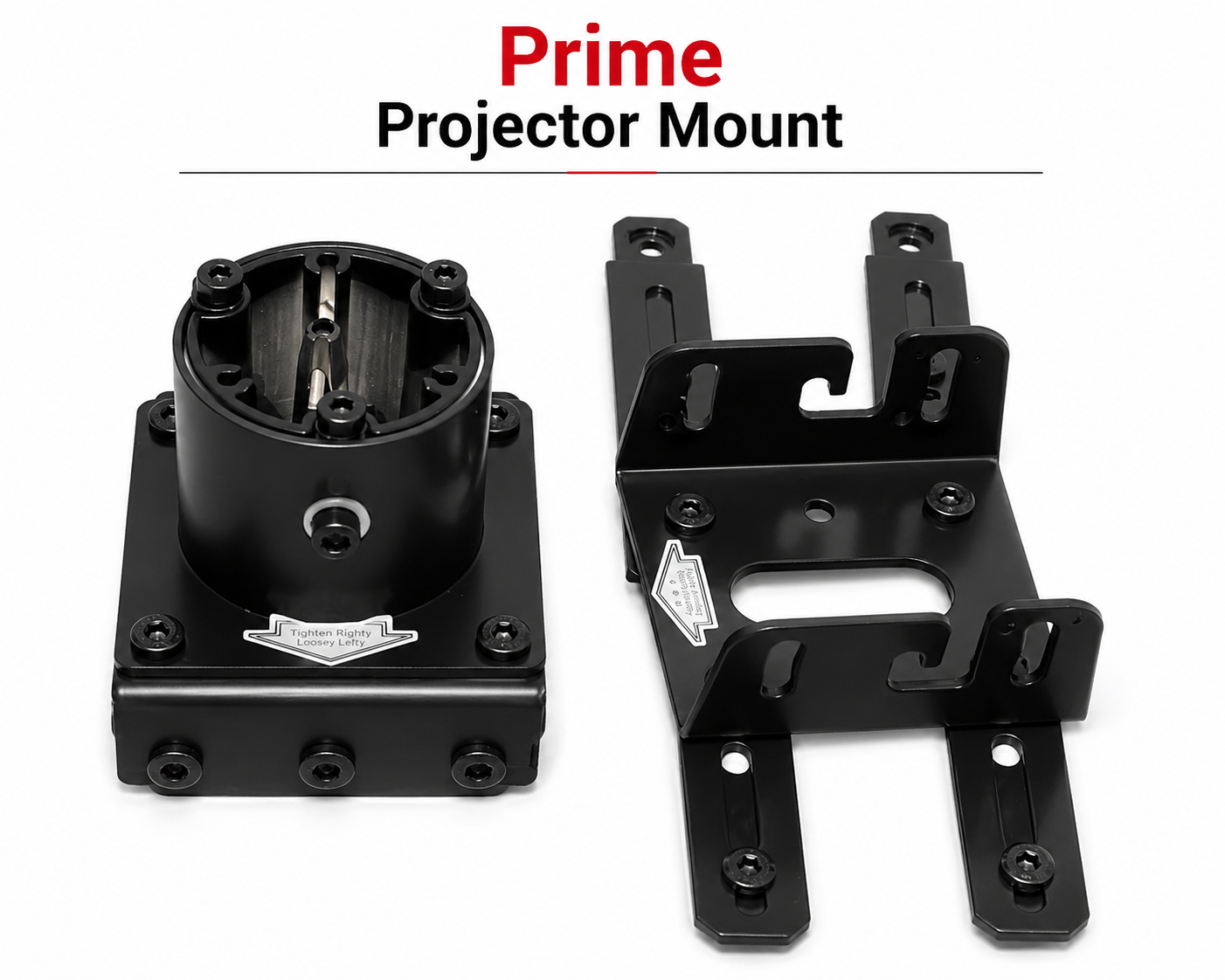
A projector hanging off your ceiling is the one spot where cutting corners is genuinely dangerous — and where a few dollars saved wrecks everything else you paid for. A cheap mount sags and drifts over time, and a projector that drifts even a little throws your perfectly calibrated image right off the screen.
Our Prime projector bracket is built for it: rated to 25kg, rigid steel, with 360° swivel, 15° tilt and 5° roll so we can line the image up exactly, four adjustable arms reaching up to 450mm, and proper mounting hardware included. That’s not where you want to save $200.
Surrounds that actually point at you.
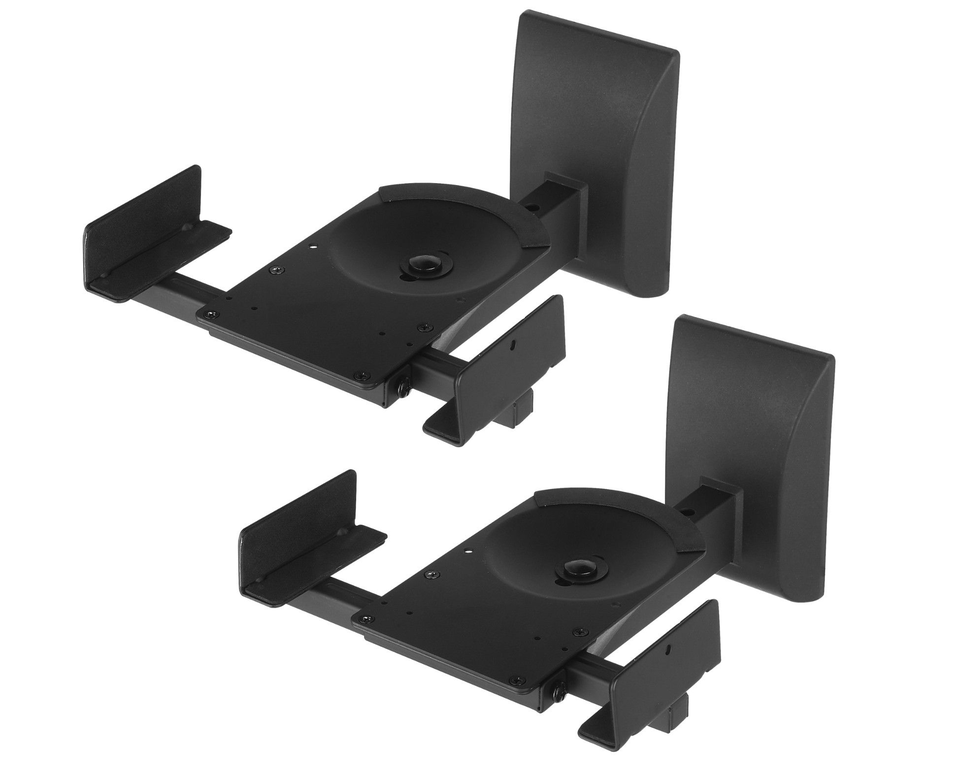
A speaker bolted flat to the wall, aimed at the ceiling, isn’t surround sound. Getting your surrounds up, out of the way, and angled at your seats is a big part of what makes a room feel immersive.
Our Prime speaker brackets do exactly that — they pivot up to 90° left-to-right to aim into the room, tilt 7° down toward you, and the clamp adjusts from 135mm to 280mm to hold the speaker securely. They’ve even got cable management built in, so we can fix to a wall stud and run the cable invisibly into the wall.
The connections you never see.
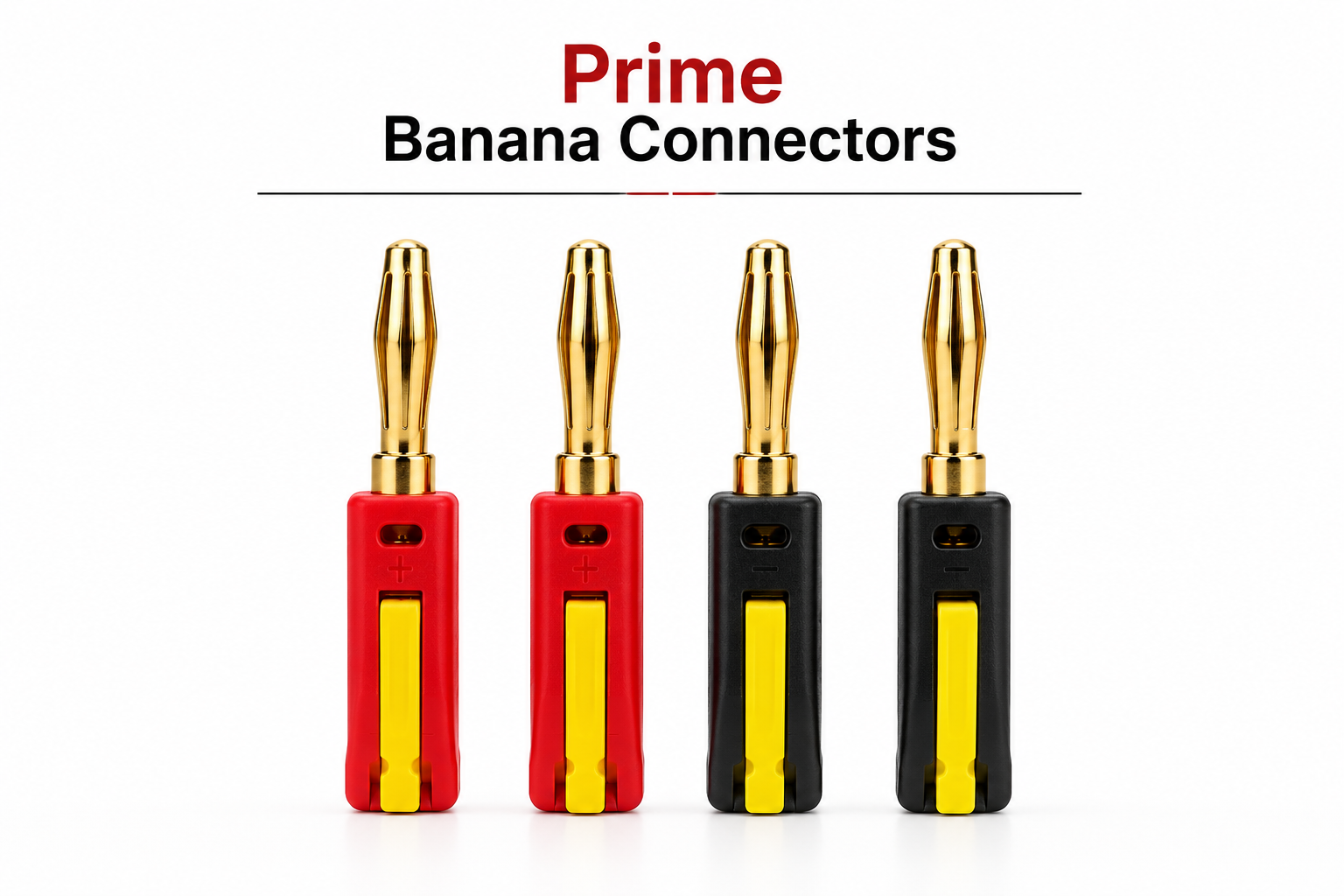
Bare speaker wire twisted under a terminal works loose, corrodes, and eventually shorts. Prime banana plugs give every channel a tight, gold-contact connection that stays put for years — and makes the whole system easy to service down the track. Across seven channels that’s about $100 in plugs alone. Small thing, big difference.
Our promise: you see every single dollar
When our number comes in higher than an “$850 install,” it’s not because we charge more for the same thing. It’s because ours actually includes the stuff that turns a pile of boxes into a real theatre — the fibre-optic HDMI, the proper cable, the plugs, the heavy-duty Prime mounts, the plaster work, the Atmos design and the full calibration — done to a standard that lasts.
And every bit of it is itemised on your quote. Every part, every service, priced honestly. We don’t quietly inflate the gear to make the labour look cheap. You’re not paying more — you’re just paying where you can see it.
That’s really the whole difference. Cheap installs hide the cost. We show you exactly what every dollar does — and then we tune the room until it sounds like the cinema you were promised.
Want a straight, itemised quote with no hidden margins? Book a free consultation and we’ll design, price and engineer your theatre properly — from the cabling up. Prefer to see what a full build looks like first? Browse our packages.
Prime Theatres — custom home cinemas across Melbourne. Honest pricing, proper engineering, every room fully calibrated.